

Maya Moon Cacao was founded by Maura and Elizabet Sacach, Kaqchikel Maya sisters from San Marcos La Laguna, Guatemala. Unlike most cacao companies covered on this site, Maya Moon is run by indigenous founders who are culturally and regionally connected to the cacao they sell. Maura handles e-commerce and brand partnerships from the U.S., while Elizabet, known affectionately as “Mama Cacao,” runs the workshop in Guatemala where all roasting, hand-peeling, and stone-grinding takes place.
Their mission statement says it plainly:
Our mission is to provide dignified work for Indigenous women especially single mothers in San Marcos La Laguna, and to build fair-trade partnerships with the farming families who grow our cacao.
Most mission statements in this industry center the product. Maya Moon Cacao centers the people around it, specifically disenfranchised communities like single mothers and indigenous women.
Preparing Cacao with an Ancestral Touch
Maya Moon Cacao offers just a handful of flagship products: organic block cacao, organic cacao powder, and organic cacao nibs, all considered ceremonial grade. The cacao is handled by members of the local indigenous people of Guatemala and is processed the way it was for many hundreds of years.
The cacao is grown in Cahabón, Alta Verapaz, Guatemala, by 195 Q’eqchi’ farming families, up from 85 in 2022. Once harvested, the cacao undergoes fermentation in banana leaves for about a week and then further dried for another week.
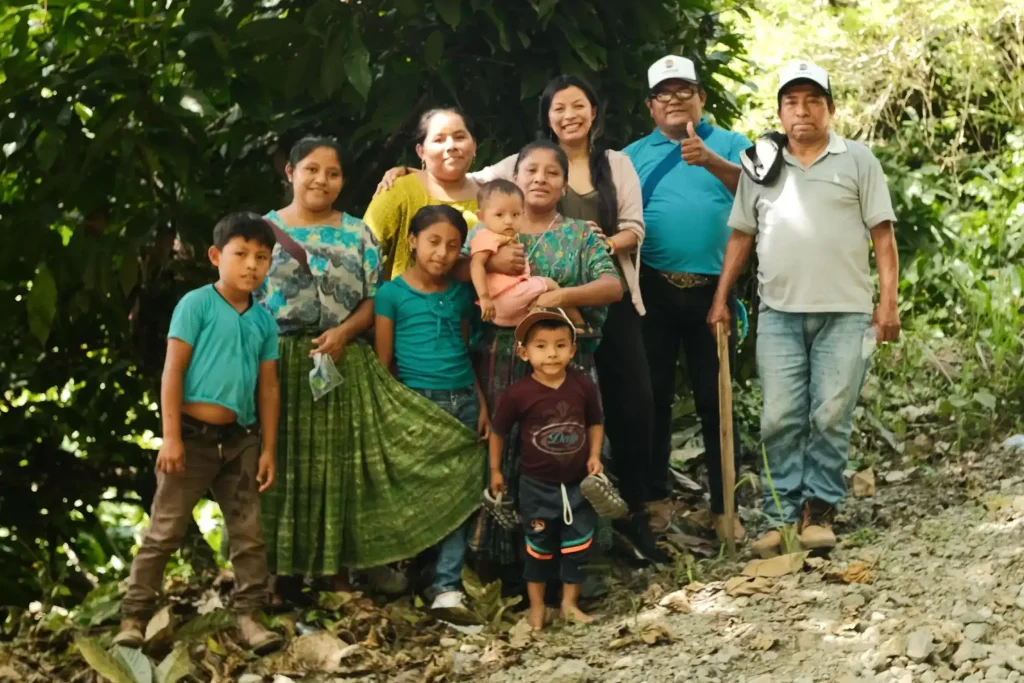
When the raw cacao is ready for roasting, it’s transported 14 hours by truck from Cahabón to San Marcos La Laguna to be processed by a group of 17 Kaqchikel single mothers. The cacao is roasted over an open flame instead of the usual stainless steel drum machines; although they state they also use an ‘artisan oven’ and judge roast profile by sensory. The women that roast the cacao are trained to listen to the cracks and other characteristics of the roasting process to achieve the perfect roast profile, and then peel and sort cacao by hand.

Once roasted, the cacao is then stone-ground also by hand into a paste where it can be turned into a rich, full bean cacao powder. Once dried, you can now brew your cacao into a traditional beverage the same way the Mayans have been drinking it for centuries. What’s most important is your cacao was meticulously cared for by a small group of families that have generational connection to cacao and directly benefit from your purchase. And I can prove it in the next part.
A Hostile Takeover and Admirable Resilience to Stay True to the Mission
Interestingly, Maya Moon Cacao experienced a recent shift in sourcing after a ‘hostile takeover’ in 2024, as I’d call it, where an intermediary offered farmers far more money for their cacao than what Maya Moon could reasonably afford. This is common in most agricultural industries, unfortunately.
We saw this with Embue Cacao around the same time period, who proudly built their entire brand on sourcing from the Q’eqchi’ community, the same greater region as Maya Moon. After being priced out, instead of reinvesting back into Guatemala, the very communities that gave the company their livelihood, Embue Cacao started sourcing through intermediaries from different global regions and rebranded away from Guatemala, undoing all their goodwill in the region.
Maya Moon is a proudly Guatemalan cacao community and losing their farming partners to exploitative big business wouldn’t waver their resolve to stay true to their mission. Maura and Elizabet worked diligently to find new partners, landing them in the Alta Verapaz region and connected with the 195 farming families that are still with them today.
Registered 501c(3) Non-profit Cacao Company
Maya Moon Cacao is probably the most unique company I’ll cover on this blog because they are registered as a 501c(3) non-profit. This can be verified by heading over to the IRS website.
Every company has a similar message about how your dollar directly supports farmers and indigenous communities, and this is topically true, but there’s nuance. You should purchase your cacao, coffee, commodity product from companies that make a meaningful attempt to show how your dollar supports farmers. However, Maya Moon Cacao doesn’t withhold profit to pad a lavish lifestyle, but instead Maura registered the company as a 501(c) non-profit to redistribute the wealth to the families in need, so you truly are putting money into the hands of the farmers and communities handling your cacao.
I looked up their public filing and can verify their status, and their mission statement in their filing matches their messaging on the website: “Provide dignified living wage to Mayan single women hand-processing cacao promoting Mayan culture and traditions.”

The filing states that Maya Moon Cacao officially became a non-profit in 2025. They generated $195,000 across donations–it’s assumed those donations came in the form of product sales–not dissimilar to how museum gift shops operate. Non-profits often time run a business to generate resources for their community. I checked Maura’s salary since it’s disclosed and it was $21,372, roughly 11% of the company revenue (no mention of co-owner Elizabet). I also researched how much of a salary can a non-profit distribute, and the IRS says it should be “reasonable” based on salary ranges of the adjacent position across all businesses. Assuming she’s working 40 hours a week, most certainly more than that, she’s making roughly $10 an hour.
I cannot confirm how much of the revenue goes back to the community, but if only $21,000 is going to Maura, then that leaves the other $174,000 going back to the stakeholders in some capacity. What matters most here is that Maura and Elizabet are truly committing their time and energy as members of the greater indigenous community to keep single mothers and impoverished families working and capable of earning income.
Recognizing Diversity in Indigenous Communities
The word ‘indigenous’ gets thrown around a lot when talking about cacao sourcing. What tends to happen, though, is while it’s technically accurate to make that claim, it’s easy to flatten all indigenous communities into a single identity, which is rarely the case. In the case of Maya Moon Cacao, each region has a unique ethnic identity that can be described as indigenous, but strips away the distinct identity of the people living there.
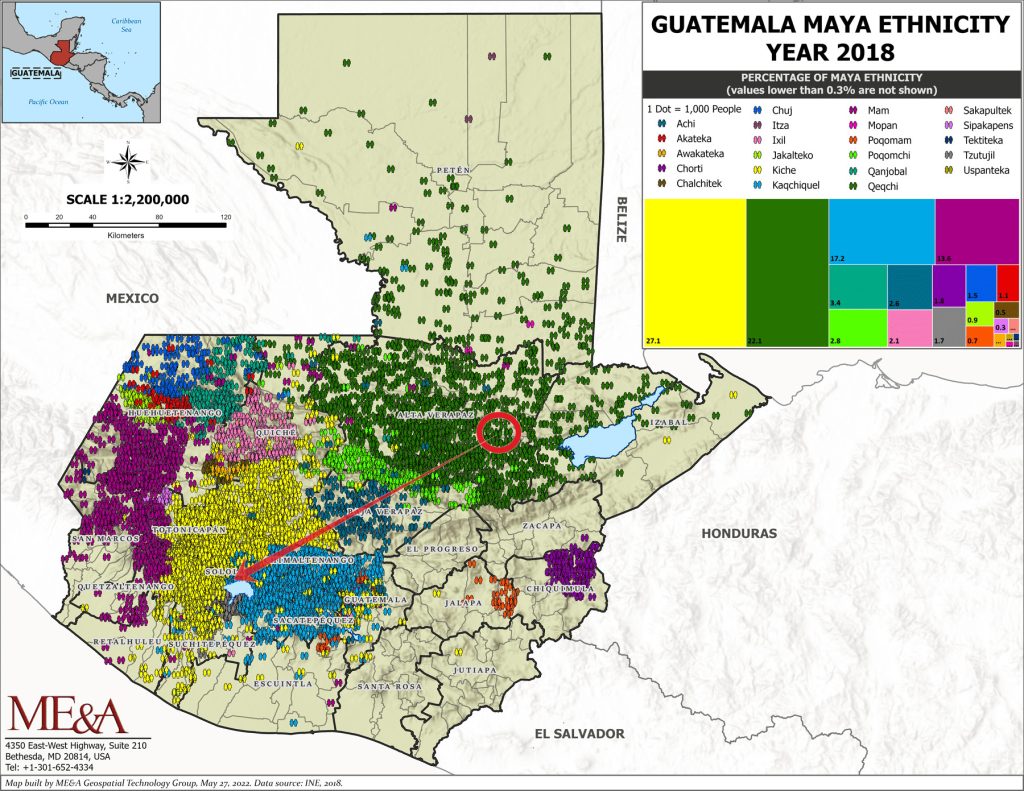
It’s important to recognize the significance of these indigenous communities and their role in the cacao journey. Cacao grows in the lower elevation regions of Alta Verapaz, the region where Q’eqchi’ people are native, and it gets transported south to San Marcos La Laguna where Kaqchikel people are native, and both, among many other groups, are members of the greater Mayan peoples. Please study the map above to get an idea of the ethnic diversity of Guatemala, and to visualize the cacao journey.
Trade relations have existed between these communities for centuries. Cacao cannot grow in San Marcos La Laguna due to its high elevation and would be more suitable for coffee than cacao. Alta Verapaz is a lowland river basin and that makes it the perfect growing conditions for cacao production. Maya Moon Cacao is actually keeping the art of ancient trade relations alive by working with their indigenous neighbors to source cacao, and then processing it by hand in San Marcos La Laguna.
Supporting Disenfranchised Families
The driving force of nearly every decision behind Maya Moon Cacao is empowering women, especially mothers in the Alta Verapaz region. According to the World Bank in 2024, Alta Verapaz has a staggering poverty rate of just over 90%, compared against the national average of 56%.

With nine out of ten people experiencing poverty in Alta Verapaz, Maura and Elizabet have tried remedying the issue by creating their non-profit to support the families and give them a sense of independence and financial stability.
Just for reference, the minimum wage for agricultural workers in Guatemala equates to about $6,100 per year. However, Guatemala’s agricultural industry has an “informality rate” of about 86%, meaning wages are not strictly enforced and laborers are severely underpaid and never even make minimum wage.
Now, let’s look at Maya Moon Cacao’s non-profit earnings. They earned ~$195,000 in 2025. Subtracting the $70,000 in expenses, that leaves a profit of about $124,000. Divided across 212 people, that’s roughly $580 per person, which happens to equal the minimum wage. Remember though, we cannot confirm where the revenue is distributed and at what percentage, but I would trust Maya Moon Cacao before almost any other company given their dedication and transparency of how they run the business.
Ceremonial Cacao True to the Definition
Another unique endeavor of Maya Moon Cacao is they are trying to establish a quality standard for what “ceremonial” means. Ceremonial is a word that has been so overused and culturally appropriated that it’s mostly lost its meaning.
Most of the cacao industry defines ceremonial as simply being pure cacao. The reason why that definition falls short is because it describes nearly every agricultural product depending on how you define it. We don’t see the ceremonial label on other produce−when’s the last time you saw ceremonial bananas? Ceremonial cucumbers?
So how is Maya Moon defining their ceremonial label? In 2025, they patented a certification known as Certified Ceremonial Cacao®, with a list of 18 criteria to earn the labeling. I won’t list all the requirements, but I’ll remark on the ones I find the most interesting. One of the requirements might draw criticism, but it’s understandable:
>Cacao is grown in a country of pre-European cacao cultivation (Mexico, Central America, South America, or the Caribbean) on farms that are 100% owned by citizen(s) of the growing country.

This regulation alone rules out 80% of the world’s cacao, since most of it comes from Africa. The sentiment makes sense, however, because cacao originated in the lower Americas where it has a cultural connection. When a “ceremonial” cacao comes from a non-origin country, whose ceremony is it referencing?
Other notable requirements are: price transparency, no synthetic chemicals, roasting and peeling are done in country of origin, 80% of farmers must be indigenous, method of peeling and grinding are on the package, cacao must be sun dried, and many more.
My primary criticism of this certification is that so far, only Maya Moon Cacao is a member after two years of establishing it. The website is hardly ever updated, looks low quality, and there seems to be no progress on it. I have a suspicion that the certification is far too restrictive that there’s not enough farms that meet the requirements, so I imagine Maya Moon may be the sole member of this certification. I’d really like to see the owners put more effort in expanding this, but after two years, it doesn’t seem likely.
Cacao Texture and Appearance
I bought a half pound bag of Maya Moon Cacao’s ceremonial cacao powder. The bag was carefully packed into a heat resistant sleeve which I really appreciated. The design of the bag felt authentic and representative of the mission. I really like it and it feels nice holding it.
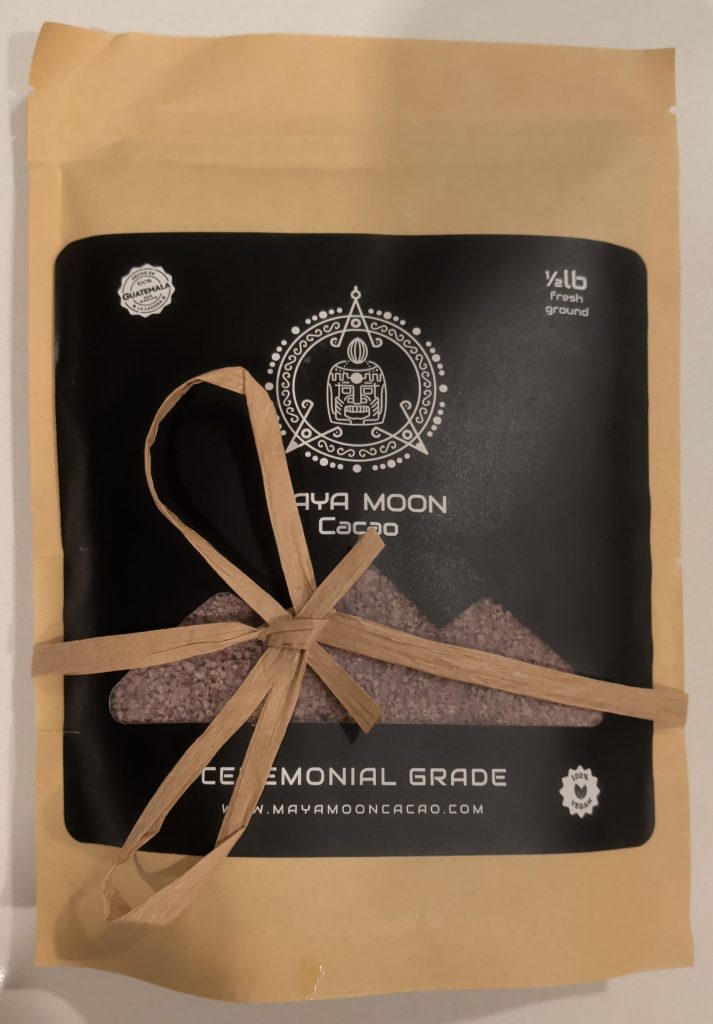
The color and consistency of the cacao is vastly different than most ground cacao beverages that I’ve tried. Maya Moon uses criollo cacao pods which are very rare, about 2-5% of all cacao and are native to Central/South America. Endless companies claim their cacao is criollo, but true criollo is expensive and difficult to maintain.
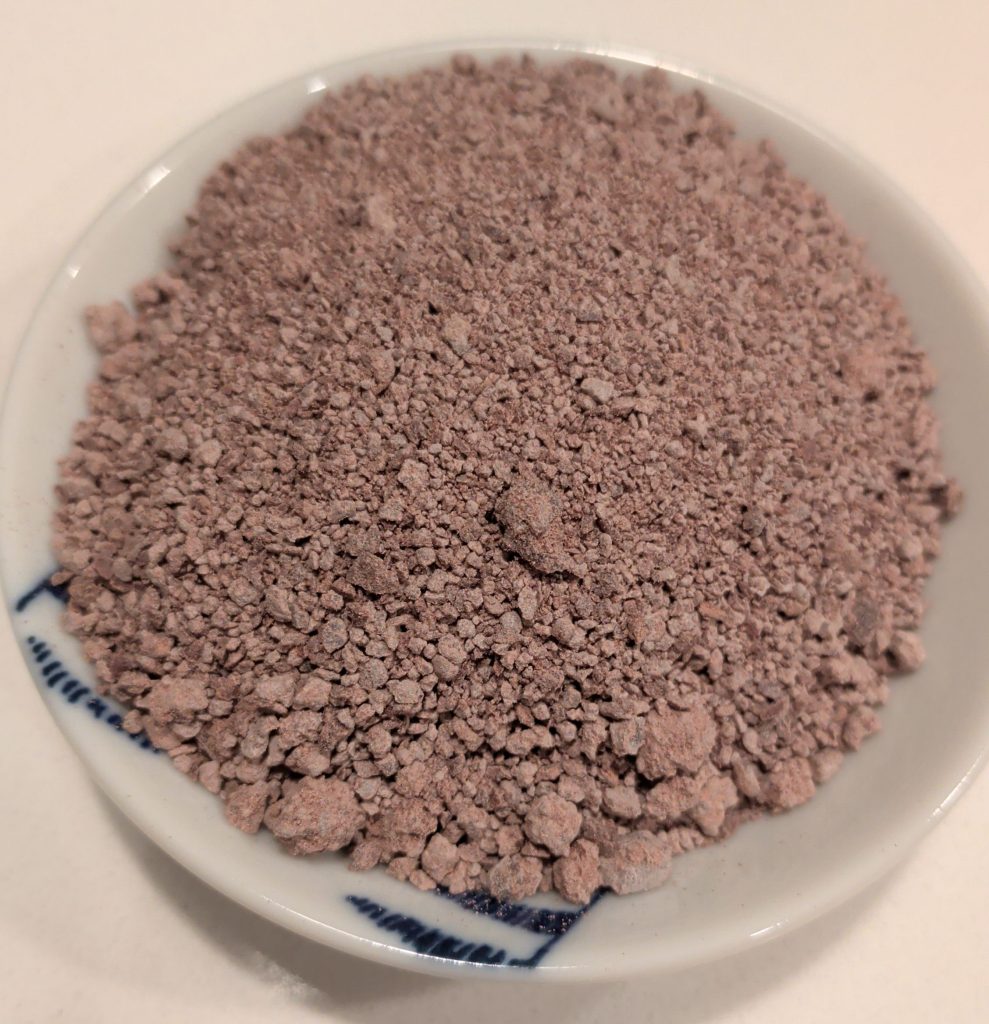
The ground cacao has this beautiful dusty mauve color that I find very appealing and is a dead giveaway that this is true criollo with a lighter roast. The consistency is pleasantly clumpy, almost like a clay. This can be attributed to the hand grinding process and explains why the acidity was well balanced on my first sip. You can actually feel the fats when touching the cacao. When cacao is ground by hand, the particles will naturally be larger causing them to stick together. The benefit of a hand ground cacao paste is that it’ll preserve nearly all of the fats and volatile aromatics that are often lost in the machine processing due to prolonged heat exposure and the mechanically refined particle sizes being so small.
How Does Maya Moon Cacao Taste?
The serving size is 3tbsp per 300ml (1 ¼ cup of) water. Much higher water content than most other cacao companies I’ve reviewed, in a good way. With most cacao beverages, I tend to use 250-300ml of water anyway since the recommended 150ml is just far too strong. Some companies even recommend 6tbsp per 150ml and at that point the cacao is so strong I feel you are just wasting it.
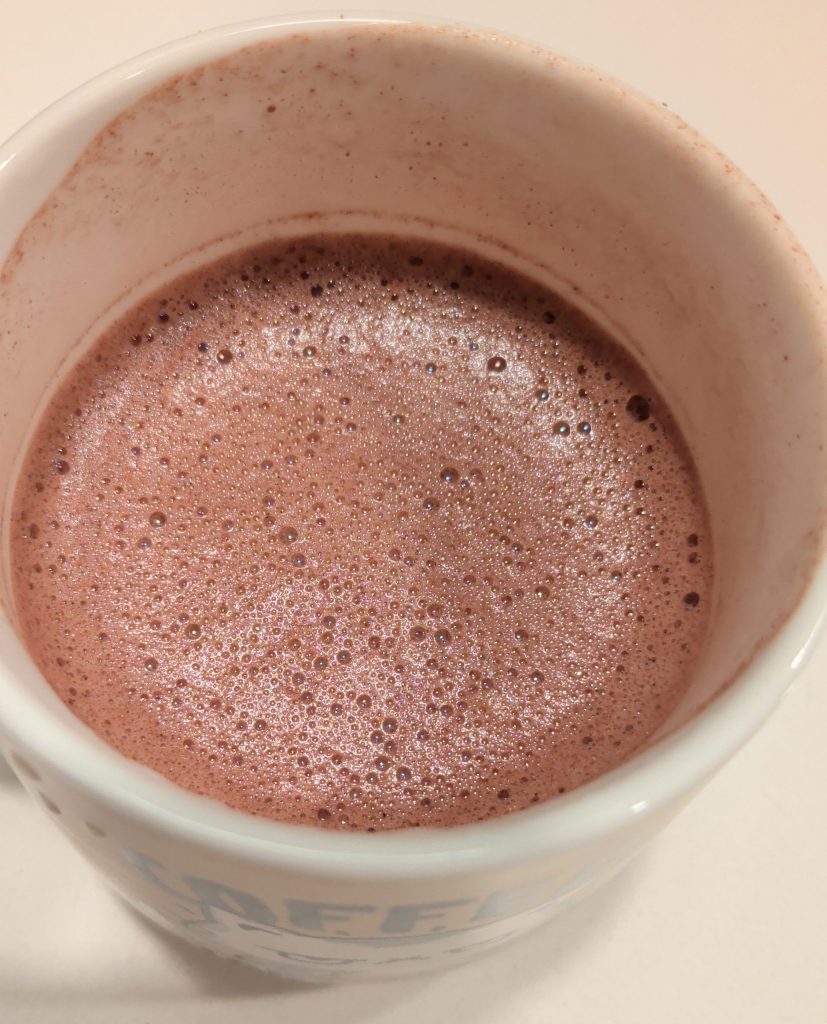
Taking my first sip was quite an experience. The cacao has a nice smooth acidity with a satisfying mouth feel. The fats give the acidity a well balanced flavor. I’d say this cacao tastes like a chocolate red wine. The dryness is mild but noticeable. On top of that, I could taste hints of raspberry too. To me, this is an indication that the cacao was perfectly fermented. There’s no aftertaste, and as the cacao cools you can definitely taste more underlying flavor notes.
No Heavy Metal Testing Available
Unfortunately, Maya Moon Cacao does not disclose their heavy metal tests. Cacao in Central and South America are typically quite high in cadmium due to the nutritious soil from volcanic activity. And when consuming whole cacao, you’ll ingest much more of those heavy metals. However, I haven’t reached out to Maya Moon for any testing, and the more I research companies, the less I put emphasis on testing, since we do not hold other industries to this standard. However, when a company promotes transparency and fails to disclose metal tests, it does spark some concern.
Final Thoughts of Maya Moon Cacao
I believe Maya Moon Cacao is one of the remaining few cacao companies that are truly living the mission they promote. Maura and Elizabet are members of the greater indigenous community they serve and are acutely aware of the commercialization of their peoples’ culture. Registering as a non-profit is a level of business operations that is unheard of in this industry. Maya Moon’s work in the Alta Verapaz region is providing critically necessary income to impoverished families. The cacao is being processed and treated as it was over the past millennia, and the quality speaks to that. A skilled person’s hands touches your cacao at every stage of the process from start to finish. If you truly want a ceremonial cacao, then Maya Moon Cacao is going to be one of your first choices. And if none of that convinced you, the cacao tastes beautiful distinct from almost any other brand on the market and the price justifies the quality you receive. I can live with that knowing where my money is going.