
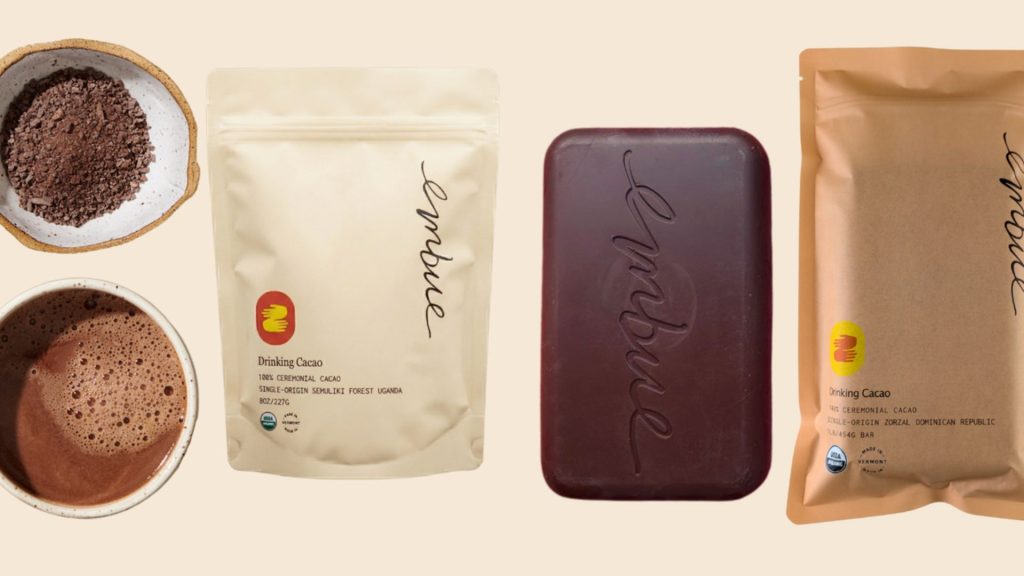
A few things have shifted at Embue Cacao since the original review published. The product line has expanded to now offering Dominican Republic and Ugandan cacao while quietly no longer offering Guatemalan cacao, and the heavy metals test page has been updated to reflect both new cacao regions that we documented previously. For the full company background, sourcing detail, and ceremonial grade breakdown, the original review covers that ground.
The allulose is gone
The earlier version of Embue’s Guatemalan chocolate contained allulose, a rare sugar that functions as a low-glycemic sweetener. The latest line of chocolate does not contain allulose anymore. No explanation appears on the site for the change, but the result is a simpler product. This section is short and sweet–pun intended. The Guatemalan chocolate contained allulose, the Dominican Republic chocolate does not.
Two new origins
Embue now sources from two new origins: the Dominican Republic via Reserva Zorzal, and Uganda via Latitude Trade Co in the Semuliki Forest region.
Here’s a quick summary of both. Reserva Zorzal is a 1,019-acre bird sanctuary (amazing right) and certified organic cacao farm in the northern mountain range of the DR. Latitude Trade Co is a certified B Corp established in 2016, working with over 4,000 smallholder producers in the Semuliki Forest region, 49% of whom are women. B Corp certification requires independent verification of social and environmental performance standards. Both are named, auditable suppliers with a public footprint.
The Guatemalan cacao, which started the company, seems to have been quietly discontinued since its metal testing has been removed from the site and the products are no longer purchasable.
Both newer suppliers cite paying above international prices and providing living wages in their published materials. Neither discloses specific prices paid to farmers.
The heavy metals math Embue won’t show you (still)
Embue publishes updated heavy metal test results for both its new origins, dated October 2025. Publishing at all puts the company ahead of most in this space so I give them credit for continuing posting the number; however, they don’t show the actual lab results or name the laboratory that conducts the test–a yellow flag for sure.
The numbers for the Dominican Republic (Zorzal) and Uganda (Semuliki) are:
Zorzal, DR: cadmium 0.2469 ppm, lead 0.0256 ppm.
Semuliki, Uganda: cadmium 0.3571 ppm, lead 0.0204 ppm.
Embue’s test page compares these figures to the Prop 65 safe harbor threshold (0.960 ppm cadmium, 0.225 ppm lead) and the EU standard (0.800 ppm cadmium, 0.100 ppm lead). Both products clear both thresholds on a per-gram basis.
That comparison is technically accurate but practically incomplete. PPM is a concentration measurement. What matters for health is how much cadmium a person actually consumes per serving, per day.
The Prop 65 Maximum Allowable Dose Level (MADL) for cadmium is 4.1 mcg per day. That figure is deliberately conservative because cadmium exposure is cumulative across everything a person eats, not just one product. Embue’s standard ceremonial serving is 28 grams. At that serving size:
One serving of Zorzal (DR) cacao delivers 6.91 mcg of cadmium, or 168% of the daily MADL. The same serving delivers 0.72 mcg of lead, or 143% of the lead MADL.
One serving of Semuliki (Uganda) cacao delivers 9.99 mcg of cadmium, or 244% of the daily MADL. The same serving delivers 0.57 mcg of lead, or 114% of the lead MADL.
For reference, the Guatemalan cacao tested at 0.543 ppm cadmium in earlier data documented in the original review. At a 28g serving that works out to 15.2 mcg of cadmium, or 371% of the daily MADL. Per full 85g bar, 46.2 mcg: more than eleven times the daily limit.
Every origin Embue currently sells exceeds the Prop 65 cadmium MADL at one ceremonial serving. Both the DR and Uganda products exceed the lead MADL at one serving as well. These are the numbers the test page does not calculate for the reader.
As an honest disclaimer, these results should NOT deter you from purchasing or consuming Embue’s cacao. But you should know the numbers if you’re trying to minimize your daily heavy metal exposure. I will always credit a company that provides testing over one that does not, despite their downplaying of the importance of Prop 65.
The original review covers sourcing, the ceremonial grade label, and the paid ceremony courses in full. Those findings have not materially changed. What has changed is the product lineup, the ingredient formulation, and what appears on the heavy metals page. The update is above.