
The Deep Dive Verdict
✅ Who’s behind this? Co-founded by Argentine siblings Federico and Florencia Fridman, who bring complementary backgrounds in health and wellness and finance. Neither holds a formal cacao certification, but they visit their Ecuadorian farmer network multiple times per year and employ a master-fermenter to oversee quality on-site. The hands-on involvement is documented and specific.
✅ Do their claims hold up? The sourcing claims are unusually detailed: old-growth Arriba Nacional heirloom cacao, exclusively from Ecuador’s Manabí province, grown in agroforestry systems without synthetic inputs. On-premises fermentation by farmers rather than centralized facilities is a meaningful structural difference from most competitors. The profit-sharing agreement claim is self-reported and unverified, but the rest of the supply chain story is internally consistent and geographically specific enough to be checkable.
✅ How transparent are they? Publishes a current Eurofins Certificate of Analysis with actual ppm figures for cadmium and lead, discloses beneficial mineral content per serving, and is upfront about “ceremonial-grade” being an unregulated label. That combination is rare in this category. The Prop 65 framing on their site leans convenient, but the raw numbers are there for readers to evaluate themselves.
⚠️ Worth your money? Cacao Laboratory operates as a deliberately small, constrained business, which keeps quality high but also means availability can be inconsistent and pricing reflects a premium supply chain. For daily ceremonial use at 28-40g per serving, cadmium intake at full doses runs above Prop 65 thresholds, not because the product is uniquely contaminated, but because 100% pure cacao concentrate is a fundamentally different thing than a chocolate bar. That’s worth understanding before committing to a daily ritual.
Cacao Laboratory: The Small Brand That Actually Shows Up at the Farm
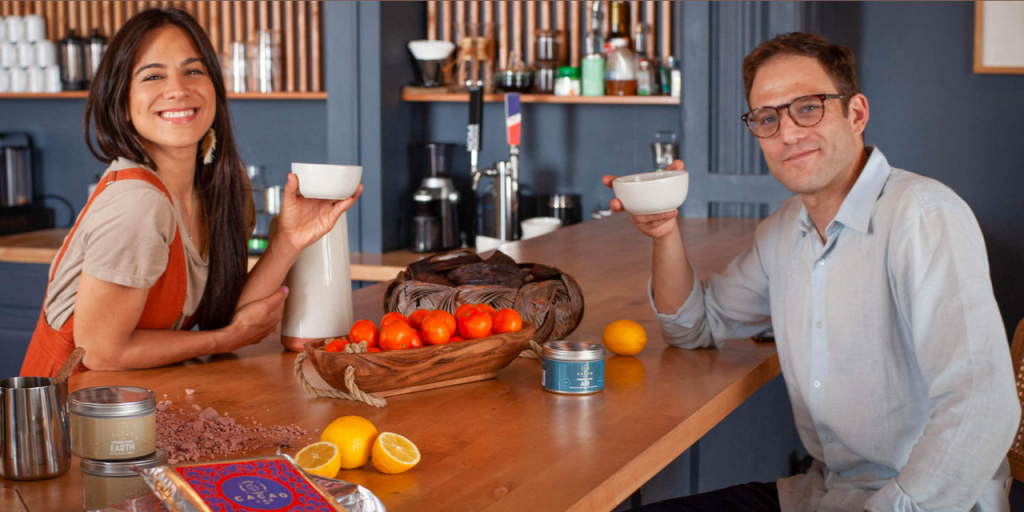
Cacao Laboratory is based out of Kingston, New York, and was co-founded by Argentine siblings Federico and Florencia Fridman. Florencia brings a background in health and wellness; Federico comes from finance and entrepreneurship. Neither holds a formal cacao certification, but what they’ve built in place of that is worth paying attention to: a small, direct-trade supply chain with farmers in Ecuador’s Manabí province, visited multiple times per year. That kind of hands-on sourcing relationship only comes from someone that travels to the location and works hands on with the community.
Who Are These Founders?
The origin story here is pretty genuine. Florencia traveled to Guatemala in 2016 and had what she describes as a transformational experience with cacao. She brought that back to her brother in New York and the two started building Cacao Lab around the idea of “shared success,” with pillars of respect, equity, and sustainability. They describe the brand itself as a laboratory in the literal sense — a place to test a different way of doing business. That framing comes up a lot across their site and it’s consistent enough that I believe it.
What gives them practical credibility isn’t their bios, though. It’s the sourcing model they’ve built. More on that below.
The Sourcing Story Is Where It Gets Interesting
Most ceremonial cacao brands purchase their beans through brokers. The broker handles processing, the brand handles marketing, and most people in between are disconnected from the actual product. Cacao Lab explicitly rejects this model and spends several paragraphs on their site explaining exactly why. I appreciated the candor.
They work exclusively with a small network of farms in Ecuador’s Manabí province, sourcing from old-growth Arriba Nacional cacao trees grown inside agroforestry systems — meaning no monoculture, no synthetic fertilizers or pesticides, and the cacao grows alongside banana, papaya, and other tropical plants that contribute to both soil health and flavor. That’s the kind of cultivation detail that matters and rarely gets disclosed.
What sets them further apart is how they handle fermentation. Many brands in this space route wet cacao through centralized regional fermentation facilities because it’s cheaper and easier to manage at scale. Cacao Lab argues that this separates farmers from ownership over their own product. Their approach is to pay farmers higher direct prices so that fermentation happens on-premises, using traditional methods and longer fermentation periods than most brands. They also employ a master-fermenter who travels between partner farms to maintain quality standards. I haven’t been able to independently verify this, but the level of specificity here is higher than most brands bother to provide.
They also claim to be the only company in the industry with profit-sharing agreements with their farmers. That’s a big statement and it’s self-reported, so take it with appropriate skepticism. But again, it’s the kind of specific, checkable claim that distinguishes a real operation from vague marketing language.
What Makes Their Cacao “Ceremonial-Grade”?

Credit is due here for an unusually honest disclosure: ceremonial-grade is not a regulated certification. Cacao Lab says this plainly on their site. There’s no governing body, no independent audit, and any company can slap the label on a product without meeting any requirements. Their version of it is framed as a production philosophy built on four things: heirloom genetics, regenerative land stewardship, fair treatment of workers, and minimal processing. That’s a reasonable definition.
On the processing side, they avoid the high-heat roasting and alkalization that’s standard in most commercial cacao products. Those processes reduce bitterness but also degrade antioxidants and strip out a lot of the nutritional properties that make 100% cacao worth buying in the first place. Nothing gets added to the product: no emulsifiers, no separated cacao butter, no tempering. Some products are ground into granules rather than formed into blocks specifically to avoid the high heat that tempering requires. Small detail, but it signals a philosophy that stays consistent down to the finishing steps.
Preparing It and Getting the Most Out of It
For anyone new to this category, their preparation page is actually useful. The recommendation is 22-30g for meditation use and 40-50g for a full ceremonial dose, mixed with hot (not boiling) water, and optionally finished with honey, maple syrup, or a plant milk. Filtered water is preferred.
A list of herbal boosters is also included: reishi, maca, cinnamon, lemon balm, and others, each with short descriptions of their traditional uses. Nothing is overclaimed, which matters. There’s no suggestion that reishi mushroom is going to cure anxiety, just that it’s a calming adaptogen with a long history of use. That’s the appropriate register for this kind of product and considerably more honest than what most wellness brands put out.
The Lab Testing: This Is the Part That Matters
Disclaimer: Cacao Laboratory has the courage to show their lab testings and regularly update them. Any other cacao company on the market that doesn’t show its testing will almost assuredly be much higher than what is shown below. Do not let this dissuade you from consuming Cacao Laboratory products, as you know what you’re getting. A company that doesn’t make public its testing is an unknown, and should be consumed with this understanding.

Cacao Laboratory publishes third-party heavy metal test results from Eurofins, a reputable independent lab. The most recent Certificate of Analysis is dated March 5, 2026. The sample tested was their 100% cacao product with a listed serving size of 28g.
The results: cadmium at 0.502 ppm and lead at 0.0409 ppm. Against EU maximum limits of 0.80 ppm for cadmium and 0.10 ppm for lead, both clear comfortably. Lead comes in at about 41% of the EU ceiling, which is a strong result. Cadmium lands at about 63% of the EU limit, which passes but is worth noting. The brand’s own claim of “roughly half” the EU limits is accurate for lead but slightly generous for cadmium.
The Prop 65 picture deserves a straightforward look. At 0.502 mcg of cadmium per gram across a 28g serving, a full serving delivers approximately 14 mcg of cadmium. Prop 65’s Maximum Allowable Dose Level for cadmium is 4.1 mcg per day for the entire diet, meaning a single full serving puts cadmium intake at roughly 3.4x that threshold. For lead, 0.0409 mcg/g across 28g comes to about 1.15 mcg per serving, against a Prop 65 MADL of 0.5 mcg, roughly 2.3x over.
That context matters, even if Cacao Lab’s Prop 65 framing isn’t wrong. Their point, that Prop 65 limits are set extremely conservatively and that the standard was designed for diluted chocolate products rather than 100% pure cacao concentrate, is factually defensible. But readers deserve the actual numbers to make that call themselves, not just the brand’s editorial take on the regulation. Consuming a full 28-40g ceremonial dose daily is a different calculation than eating a few squares of 70% chocolate. If cadmium is a concern, a smaller daily serving or less frequent use is a reasonable adjustment.
The mitigation work they describe is genuine. Shaded, raised drying beds reduce atmospheric lead exposure, and sourcing from volcanic Manabí soil means cadmium absorption is a known and unavoidable reality of the terroir. They understand the contamination pathways, which is more than most brands can say. Publishing a Eurofins COA at all puts Cacao Laboratory ahead of the large majority of this market. The numbers just warrant reading directly rather than through the brand’s summary of them.
The Bottom Line
Cacao Laboratory is doing supply chain work that most ceremonial cacao brands claim to do but don’t. The sourcing is specific and geographically rooted, the testing is current and from a credible independent lab, and the honesty about what “ceremonial-grade” actually means and doesn’t mean is refreshing in a market that trades heavily on vague language.
The COA numbers are now on the table: lead at 0.0409 ppm is a genuinely strong result for this category. Cadmium at 0.502 ppm clears EU limits but adds up at full ceremonial serving sizes, and that’s worth understanding before committing to a daily ritual. That’s not a knock on Cacao Lab specifically; it’s the reality of consuming 100% pure cacao concentrate, and the fact that they publish the numbers at all puts them ahead of most competitors who simply don’t.
For health-conscious buyers who want to know where their cacao comes from and what’s actually in it, Cacao Laboratory is one of the more credible options in this space.