

From Mason Jars to TikTok
Dave Chmielewski was the kind of guy who cooked for the crew. When he started making his almond toffee, the response was immediate: people started calling the house asking for more. He slapped some homemade labels on Ball mason jars and started selling at local craft shows. Word kept spreading.
His son, Andrew, was studying business administration and marketing at Oakland University when he started joining his dad at those craft shows. He saw what the toffee was doing to people and made a decision: quit school, go all in. In early 2011, he founded Dave’s Sweet Tooth Toffee as a formal business, naming it after his dad. The kitchen that launched it all eventually couldn’t keep up, and Dave’s mom made it very clear the family needed their kitchen back.
From there, the brand grew steadily. Appearances on The Today Show and Good Morning America pushed sales dramatically. Andrew landed on Forbes 30 Under 30 in 2017 in the food and drink category. The operation eventually moved into a 5,000-square-foot factory in Harrison Township, Michigan. The toffee picked up distribution in Kroger, Whole Foods, and specialty retailers. By any measure, the Chmielewski family turned a hobby into a legitimate American small business success story.
Then TikTok happened.
Dave’s Sweet Tooth has sold over 427,000 units through TikTok Shop and has nearly 400,000 followers on the platform. With average order values likely sitting somewhere in the $40 to $60 range, that’s a rough estimate of $17 million in gross TikTok revenue alone. That number is speculative based on rough math, but the scale is real: this is a viral product with genuine staying power on a platform that has burned countless other brands with fleeting 15-second fame.
Toffee 101: What You’re Actually Eating
Before getting into the product itself, it’s worth spending a moment on what separates toffee from caramel, because a lot of new Dave’s customers are coming in blind.
Both toffee and caramel start from the same basic place: sugar and butter, cooked with heat. The difference is how far you take it. Caramel is pulled off the heat at a lower temperature, typically around 230 to 245 degrees Fahrenheit, which leaves it soft, pliable, and chewy. It melts slowly, clings to your teeth, and has that familiar golden-sweet pull most people know from candy bars. Toffee gets cooked longer and hotter, well into the hard crack stage above 300 degrees Fahrenheit, then poured flat to set. The result is a harder, crunchy, brittle candy with a more intense, slightly caramelized butter flavor.
The practical difference for the consumer comes down to preference and dental tolerance. Caramel gives you chew; toffee gives you snap. People who love caramel tend to enjoy that slow, teeth-coating melt and the way it lingers. People who prefer toffee usually want something more confectionary and less sticky: a candy with structural integrity that breaks cleanly rather than glues itself to your molars.
Dave’s version leans into the toffee identity but markets itself as softer than traditional English toffee, which is accurate. It has a cookie-like crunch rather than the glass-shard brittleness of hard buttercrunch. That said, it is still toffee, and the stickiness is real.
How’s the Product: A Personal Take
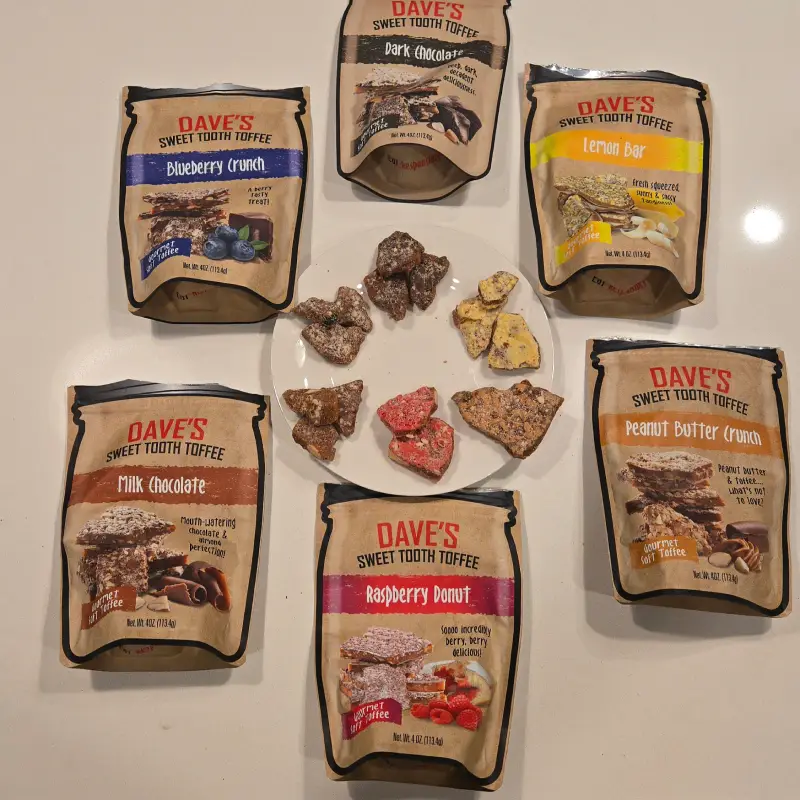
We here at Consumer Deep Dive bought a few bags and had to dig in.
The six-pack sampled included peanut butter, dark chocolate, milk chocolate, lemon, blueberry, and raspberry. The peanut butter was the clear winner: rich, salty, and well-balanced against the butter base. The lemon was a strong runner-up with a bright, genuine citrus pop that didn’t taste artificial.
The toffee itself is exactly what a decent toffee should be. The flavor is good, the crunch is satisfying, and the toppings are generous, and the chunks are respectfully large, just look at that peanut butter crunch!! There’s no stinginess with ingredients here.
One honest note: speaking as someone with poor quality teeth, the toffee did painfully stick, despite the brand’s claims to the contrary. Dave’s markets itself as easier on the teeth than traditional English toffee, and relative to a glass-hard buttercrunch, that’s probably true. But for anyone with fillings, crowns, or teeth that don’t appreciate a fight, chew carefully. This isn’t a knock on the brand, it’s a realistic expectation-setter for people who’ve never had toffee before and are coming to the product fresh from TikTok. The volume of customers encountering toffee for the first time through Dave’s is meaningful, and the stickiness will surprise some of them.
Overall verdict on the product itself: it’s good. Not transformative, but solidly made and worth buying.
The Politics Are the Point

Dave’s Sweet Tooth has built a second identity as one of the most openly political small brands on TikTok, and it’s intentional.
The brand has created custom bundles and packaging with names mocking the current administration: the Big Beautiful Bundle (a direct jab at the Big Beautiful Bill), Liberal Tears, M-Peach-Ment, and others. Andrew has stated explicitly that customers who support MAGA are not the customers Dave’s wants. That kind of public positioning is rare for a small candy company, and it’s working: the controversy keeps them in the algorithm, the political identity builds loyalty with their audience, and the media attention costs nothing. The upside is that it’s generating organic press and TikTok engagement that money can’t buy. For now, it’s working, and the brand owns it.
Transparency Through the Camera
One of the more genuinely impressive things about Dave’s Sweet Tooth is how much of the actual production process has been documented on TikTok. Going back to 2023 and 2024, there are videos of toffee being spread on sheet pans, toppings being added by hand, and product being packed for shipment. The owners are on camera. The facility is on camera. The ingredients going in are on camera.
This is meaningful. A lot of brands in the confection space talk about small-batch and handmade without ever showing it. Dave’s has shown the work. The videos communicate genuine care: toppings are applied generously, the process is clearly hands-on, and the team is visibly involved. That level of visual transparency builds credibility in a way that “handmade in Michigan” on a label simply cannot.
The Ingredient List: Cleaner Than Most, Not as Clean as Claimed
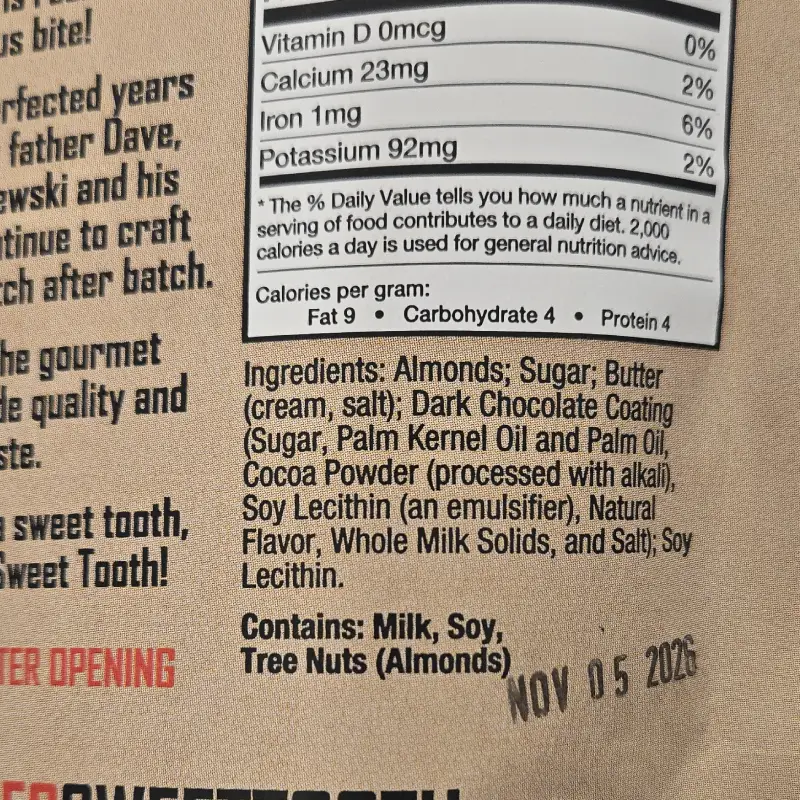
Here’s where the honest assessment gets a little more complicated.
Dave’s most consistent marketing claims are that the toffee has no preservatives and is gluten-free. Both appear to be accurate. The core ingredient list across the flagship flavors reads like a short-form pantry: butter (milk, salt), sugar, almonds, and then whatever chocolate or flavoring applies. Compared to mass-market candy brands layering in artificial flavors, corn syrup, and stabilizers, Dave’s is legitimately cleaner.
But “no preservatives” is not the same as “clean,” and a few ingredients in the lineup deserve closer attention.
Soy Lecithin: Present in the chocolate coatings across multiple flavors. Soy lecithin is an emulsifier: it’s extracted from soybean oil during processing and added to foods to help ingredients bind that wouldn’t otherwise mix, like fat and water. It’s everywhere in commercial chocolate because it extends shelf life, improves texture, and reduces the amount of cocoa butter needed. The controversy around it is layered. The overwhelming majority of soybeans grown in the United States are genetically modified, which means soy lecithin in most commercial applications comes from GMO soy. There are also ongoing debates about trace phytoestrogens and whether the processing methods used to extract it, often involving hexane, are desirable in a food labeled as clean. Sunflower lecithin is commonly cited as the cleaner alternative. None of this makes soy lecithin dangerous at normal consumption levels, but it does push back against a “simple, real ingredients” brand narrative when it shows up in the chocolate.
Palm Kernel Oil: Present in the dark chocolate used across multiple flavors. Palm kernel oil is not the same as palm oil, though they share sustainability concerns. It’s high in saturated fat and is used commercially because it’s cheap, stable, and gives chocolate a smooth melt. Its presence is a strong indicator that the dark chocolate Dave’s uses is sourced from a third-party commodity supplier rather than a premium cocoa source. There’s no evidence of quality assurance behind the specific chocolate, and the brand doesn’t disclose suppliers. This isn’t unusual for a small confectioner, but it’s relevant context for anyone reading “real ingredients” on the label and assuming premium chocolate sourcing.
Vanillin: Found in both the milk chocolate and peanut butter chip ingredients. Vanillin is the primary aromatic compound found in natural vanilla beans, but when it appears in ingredient lists independently, it’s almost always synthetic. Synthetic vanillin is manufactured from lignin (a wood pulp byproduct), guaiacol (a petroleum derivative), or other industrial sources. It replicates the dominant note of vanilla flavor but lacks the hundreds of additional flavor compounds present in real vanilla extract. It’s common, it’s inexpensive, and it’s not dangerous, but it’s a synthetic flavor substitute appearing in a product marketed on the strength of its real, simple ingredients. Worth knowing.
Partially Defatted Peanuts: Found in the peanut butter chips used in the peanut butter flavor. Defatted peanuts are exactly what they sound like: peanuts with a portion of their natural fat removed through mechanical pressing or solvent extraction. Yes, the primary purpose is to reduce the fat and calorie content of the final product, which allows manufacturers to create a more shelf-stable, lower-fat chip with a different texture than one made from whole peanut butter. What’s lost in the process is flavor complexity and the natural oils that make peanuts taste like peanuts. The peanut butter chips in Dave’s peanut butter flavor also include palm kernel oil, corn syrup solids, dextrose, and soy lecithin layered on top of the defatted base. It’s a heavily processed ingredient in a product that markets on simplicity.
The honest grade here is a C+. The toffee is cleaner than most of what fills the candy aisle, and the no-preservatives claim holds. But “no preservatives” is doing a lot of heavy lifting when the product also contains synthetic vanilla, defatted peanut chips, commodity dark chocolate with palm kernel oil, and GMO-derived emulsifiers. Informed ingredient readers will notice the gap between the brand’s framing and what’s actually in the bag.
The AI Label Situation
This one is current and still developing as of this writing.
Dave’s Sweet Tooth recently came under public scrutiny for using AI-generated imagery on product labels, apparently created through Canva’s AI features. Andrew’s response to the criticism suggested genuine unfamiliarity with what AI-generated art actually is: he appears not to have realized Canva was using generative AI to produce the images, and seems to be sorting out what that means in real time.
For most brands, this would be a minor controversy. For a brand that has built significant equity on being “for the little guy,” made by real humans, against the machine in both the political and commercial sense, using AI-generated art on product packaging creates a specific kind of credibility friction. It’s not a moral catastrophe. But it does reveal a gap in decision-making around brand values: if the entire identity rests on authenticity and the human touch, the design decisions need to match that identity all the way to the label.
Andrew seems like someone who genuinely didn’t know better. That’s not a character indictment. But better diligence before the labels went on a commercial product would have been the right move.
Bottom Line
Dave’s Sweet Tooth Toffee is a brand worth supporting. The origin story is real, the production is transparent, and the people behind it are visibly invested in what they make. The toffee itself is good. The ingredients are cleaner than the category average, even if they fall short of the “simple, real ingredients” framing the brand leans on.
The gaps are real but not deal-breaking: commodity chocolate sourcing, synthetic flavor substitutes, processed peanut components, and a recent lapse in brand consistency around the AI label situation. None of it sinks the product. Andrew isn’t running a spotless operation, but he’s running an honest one by small-business standards, and the family involvement and hands-on manufacturing are genuine.
Buy it, enjoy it, chew carefully if your teeth have opinions, and know what’s in the bag before assuming the marketing is the whole picture.